



Let’s be honest: in 2026, making things “look pretty” is no longer a superpower; it’s the bare minimum. With trends cycling faster than ever and AI tools generating impressive visuals in seconds, how do you stand out as a designer? How do you command higher rates and win the complete trust of your clients?
According to a highly insightful video by Satori Graphics titled “4 Graphic Design Tips For ELITE Design Thinkers!”, the answer isn’t in mastering a new font or software. The real shift happens in your mindset.
To move from a simple “asset producer” to a strategic “creative director,” you need to evolve. Here is a summary of the 4 brutal, yet essential skills that elite design thinkers use to dominate the industry.
1. Mastering Visual Positioning (The “Saturation Audit”)
Do you just open Pinterest for inspiration and build a design that looks good in isolation? If so, you might be unintentionally failing your client. Let’s say you’re designing for a tech startup and you use soft gradients, rounded UI, and a muted blue palette. It looks clean and professional, right? Yes, but it also makes the brand invisible. Because everyone else in that niche is doing the exact same thing. Elite designers do what’s called a “saturation audit.” They pull up 10–20 competitors, look at them side-by-side, and ask: “What is expected here?” Then, they strategically decide whether to blend in intentionally or disrupt the market completely. Knowing where your design fits in the cultural landscape doubles its value.
2. Selling Certainty, Not Just Pixels
When you send a proposal, what are you actually selling? If you think you’re just selling logos or website layouts, you are severely limiting yourself. Elite designers understand that they are selling certainty and peace of mind. This is where the psychology of design comes into play. For instance, the Authority Bias. If you present your work by saying, “Here’s a logo I made,” you sound like a junior. But if you say, “This identity system was built to increase brand recall through tailored typographic contrast,” you instantly sound like a strategic partner. Humans trust clarity. Confident, decisive communication elevates you from a pixel-pusher to an authority.
3. Optimizing for the Speed of Cognition
We currently live in a 2-second attention economy. You have 2 seconds to interrupt a scroll, 2 seconds to establish hierarchy, and 2 seconds to communicate your core message. If your design requires the viewer to “be patient,” it will fail. Elite design thinkers optimize for the speed of cognition. Here is a practical test: scale your design down to 10% (roughly the size it appears on a mobile feed). What is the very first thing you see? If the answer is “everything at once,” your design is too cluttered. You need high contrast, one clear entry point, minimal competing elements, and an immediate hook. Reduce the noise until the core message hits instantly.
4. Building Narrative Architecture
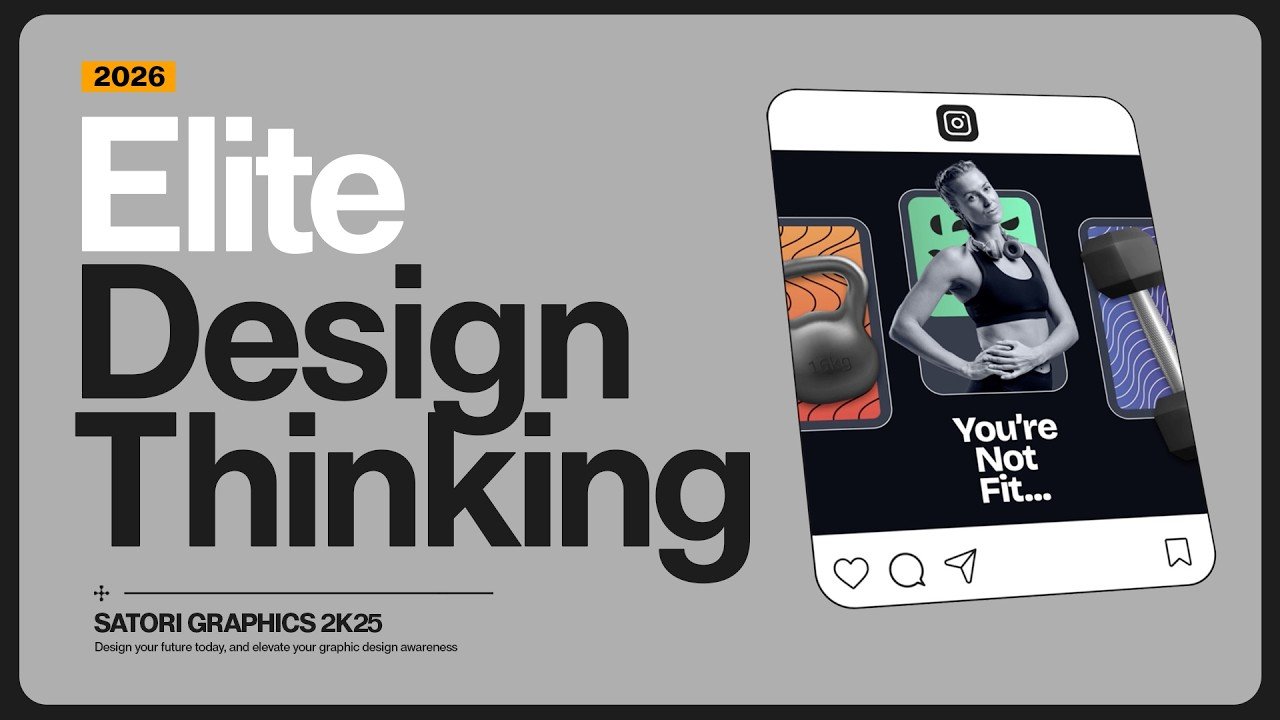
A strong design is an asset; a sequenced design is an experience. Think about an Instagram carousel. Most designers treat every slide exactly the same—same grid, same headline placement, just different text. It’s consistent, but it’s boring. Instead, think like a director building a narrative architecture. Slide 1 creates tension. Slide 2 expands the context. Slide 3 shifts the focal point to a key statistic. Slide 4 provides a visual breather. Slide 5 delivers the confident, clean call to action. By controlling the rhythm, pacing, tension, and release, you are not just designing graphics; you are guiding a journey.
(Speaking of guiding user journeys, have you optimized your website’s layout for maximum engagement? Check out our article on [Link to Article: 5 Top UI/UX Design Trends in 2026 to Keep Your Website Visitors Hooked]).
Ready to Think Bigger?
The shift from being a “designer” to an “elite design thinker” involves understanding context, psychology, speed, and narrative. It’s about building brands that don’t just look good, but actually work in the real world.
At Foxtrot Studio Bali, we don’t just push pixels; we provide strategic visual solutions. Through our Unlimited Design Subscription, we bring elite design thinking to every project, ensuring your brand stands out, connects, and converts. Let’s talk strategy and elevate your business today!


Leave a Reply